Last Updated: August 24, 2026, 9 am UTC
The U.S. Food and Drug Administration’s (FDA) renewed focus on drug repurposing is bringing fresh attention to a regulatory pathway that has quietly shaped drug development for decades: 505(b)(2). Starting out as a critical mechanism bridging the gap between traditional 505(b)(1) new drug applications and abbreviated new drug applications (ANDAs), its adoption expanded over time as sponsors recognized its strategic value and FDA refined its expectations.
A May 2026 request for public input initiated its most recent move to the forefront. FDA emphasized that identifying new uses, indications, or patient populations for already approved drugs may help accelerate treatment availability by using existing knowledge about those products, including their safety profiles.[1]
The Agency is seeking input from patients, clinicians, researchers, and other stakeholders on priority disease areas and potential candidates for repurposing. FDA highlighted several areas of interest, including chronic diseases, rare diseases, neurodegenerative conditions, metabolic diseases, substance use disorders, women’s health conditions, and men’s health conditions, while also inviting stakeholders to identify other areas that should be prioritized.[1]
For sponsors, the announcement is a timely reminder that drug repurposing is not only a scientific opportunity. It is an opportunity to reframe a program’s regulatory and commercial strategy to take advantage of the streamlined 505(b)(2) pathway.
Why 505(b)(2) Matters for Repurposed Products
Drug repurposing refers to identifying potential new uses — such as a new indication or new patient population — for FDA-approved drugs, where the new use would be supported by safety and effectiveness data.[2] For sponsors pursuing those new uses, the 505(b)(2) pathway can be an important regulatory advantage.
A 505(b)(2) application is a new drug application that contains full reports of investigations of safety and effectiveness, where at least some of the information required for approval comes from studies not conducted by or for the applicant and for which the applicant does not have a right of reference.[3] FDA’s 2019 final guidance on determining whether to submit an ANDA or a 505(b)(2) application describes 505(b)(2) as one of the abbreviated approval pathways under the FD&C Act and provides considerations to help potential applicants determine whether a proposed product is more appropriate for 505(j) or 505(b)(2) pathways.[4]
For repurposing programs, these distinct pathways can be highly valuable. A 505(b)(2) strategy may support development of a new indication, dosage form, route of administration, formulation, dosing regimen, or patient population, provided the sponsor can scientifically justify reliance on existing information and address the gaps needed to support the proposed labeling.
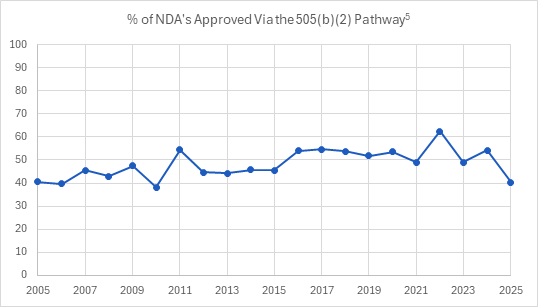
The pathway is also well established. 505(b)(2) matured substantially over time due to industry leaders’ collaboration with FDA and advances in scientific methodologies and enabling technologies. Premier Research’s proprietary 505(b)(2) database shows that, from 2005 through 2025, 505(b)(2) approvals generally accounted for approximately 40% to 60% of NDA approvals annually, with 2025 remaining within that long-term range.[5] This stability underscores its role as a mature and reliable mechanism for enabling efficient drug development, lifecycle innovation, and repurposing strategies.
For sponsors exploring repurposing opportunities, it is critically important to understand the pathway early — before development plans, evidence-generation strategies, and regulatory interactions become misaligned.
The Importance of Early FDA Engagement
Early FDA engagement is especially important. FDA’s Pre-Investigational New Drug Application Consultation Program is intended to foster early communication between sponsors and review divisions and provide guidance on the data needed to support IND submission.[6] FDA’s formal meetings guidance also notes that meeting requests should include the proposed regulatory pathway, such as 505(b)(1) or 505(b)(2), to ensure sponsors are thinking about the appropriate pathway questions early in development.[7]
For repurposed products, these discussions may be used to clarify the relevance of existing evidence, identify whether additional pharmacology, toxicology, clinical pharmacology, efficacy, or safety data are needed, and determine how to bridge from the referenced product or literature to the proposed new use. Without this early alignment, sponsors may overestimate how much existing evidence can support approval — or, conversely, conduct unnecessary studies that add cost and time without strengthening the application.
FDA-Led Labeling Updates and Sponsor-Driven Development
FDA’s announcement also highlights a related but distinct issue: what happens when sufficient evidence may support a new use, but there is little or no commercial incentive for an application holder to pursue a labeling change. FDA’s efforts to modernize legacy labeling align with a broader push to facilitate repurposing, leveraging streamlined pathways like 505(b)(2) to bring existing evidence into approved use particularly where limited commercial incentives may otherwise hinder labeling updates.
FDA noted that its current effort builds on existing initiatives, including the Best Pharmaceuticals for Children Act (BPCA), the MODERN Labeling Act, and Project Renewal, which has updated labeling for several oncology drugs to reflect current scientific understanding.[1] To date, Project Renewal approvals have included updated labeling for capecitabine, temozolomide, and fludarabine phosphate.[8]
While initiatives such as the MODERN Labeling Act and Project Renewal reduce barriers and improve the commercial viability of repurposing, BPCA provides a direct 6‑month exclusivity incentive—together supporting repurposing through pathways such as 505(b)(2).
While FDA-led labeling updates may be appropriate in select circumstances, many repurposing opportunities will still require sponsor-driven development and a clear regulatory plan.
Turning Repurposing Potential into an Approvable Path
FDA’s request for input further clarifies the types of candidates that may be especially relevant. The Agency is seeking information on candidates where sufficient evidence may already exist to support a potential new use, candidates with promising preliminary clinical data, and candidates with promising preliminary nonclinical data that may warrant further study.[9] FDA also identifies potential examples that may be especially well suited for repurposing consideration, including approved drugs with compelling evidence for the new use, the same dosage form and route of administration as an approved indication, and a comparable safety profile in the proposed patient population.[2]
For sponsors, this creates both opportunity and complexity. A promising repurposing hypothesis is only the starting point. Successful execution requires a disciplined assessment of the evidence, a clear understanding of the regulatory pathway, and a development plan that anticipates FDA’s expectations for safety, efficacy, labeling, bridging, and reliance.
Industry leadership has been instrumental in translating this renewed focus into actionable development outcomes, with Premier playing a central and defining role in advancing 505(b)(2)-driven repurposing strategies. Through sustained engagement with sponsors, deep scientific and regulatory expertise, and direct collaboration with the FDA, Premier has been at the forefront of advancing understanding of the pathway and operationalizing its use. For organizations pursuing drug repurposing programs — especially those less familiar with 505(b)(2) applications or the importance of early FDA engagement — that experience can help turn scientific promise into a more efficient, regulatorily sound path forward.
As FDA places renewed attention on repurposing to address unmet medical needs, sponsors have an important opportunity to reassess existing assets, emerging evidence, and development strategies. The right regulatory pathway, supported by the right evidence plan, can make the difference between an interesting hypothesis and an approvable new use that reaches patients. Contact us today to discuss your program.
About Premier Research
Premier Research International LLC (Premier) is a leading global clinical research organization (CRO) and consulting partner with expertise in driving an efficient and effective path to market for the life sciences industry. Built with the needs of biotech in mind, our integrated approach helps life science innovators turn breakthrough science into life-changing drugs, devices, and diagnostics by addressing trial complexity, overcoming development hurdles, and demonstrating product value.
A 505(b)(2) program offers an opportunity to streamline development plans and accelerate approval timelines often at a reduced cost; however, the complexity of this pathway demands historical insight and creative thinking. Premier’s 505(b)(2) experience is unmatched. We’re helping sponsors leverage this unique development opportunity with tailored regulatory and strategic support that reflects the specialized nature of this pathway.
Learn more about our 505(b)(2) development expertise.
REFERENCES
- U.S. Food and Drug Administration, “FDA Advances Drug Repurposing to Address Unmet Medical Needs,” May 11, 2026.
https://www.fda.gov/news-events/press-announcements/fda-advances-drug-repurposing-address-unmet-medical-needs
- U.S. Food and Drug Administration, “Drug Repurposing,” May 11, 2026.
https://www.fda.gov/drugs/resources-drugs/drug-repurposing
- U.S. Food and Drug Administration, “Overview of the 505(b)(2) Regulatory Pathway for New Drug Applications.” https://www.fda.gov/media/156350/download
- U.S. Food and Drug Administration, “Determining Whether to Submit an ANDA or a 505(b)(2) Application,” May 2019.
https://www.fda.gov/regulatory-information/search-fda-guidance-documents/determining-whether-submit-anda-or-505b2-application
- Premier Research, “% of NDA’s Approved Via the 505(b)(2) Pathway,” proprietary 505(b)(2) database, updated through 2025.
- U.S. Food and Drug Administration, “Investigational New Drug (IND) Application.”
https://www.fda.gov/drugs/types-applications/investigational-new-drug-ind-application
- U.S. Food and Drug Administration, “Formal Meetings Between the FDA and Sponsors or Applicants of PDUFA Products,” Draft Guidance, September 2023.
https://www.fda.gov/media/172311/download
- U.S. Food and Drug Administration, “Project Renewal.”
https://www.fda.gov/about-fda/oncology-center-excellence/project-renewal
- Food and Drug Administration, “Drug Repurposing for Unmet Medical Needs; Request for Information,” Federal Register, Vol. 91, No. 91, May 12, 2026.
https://www.federalregister.gov/documents/2026/05/12/2026-09366/drug-repurposing-for-unmet-medical-needs-request-for-information
Authors